
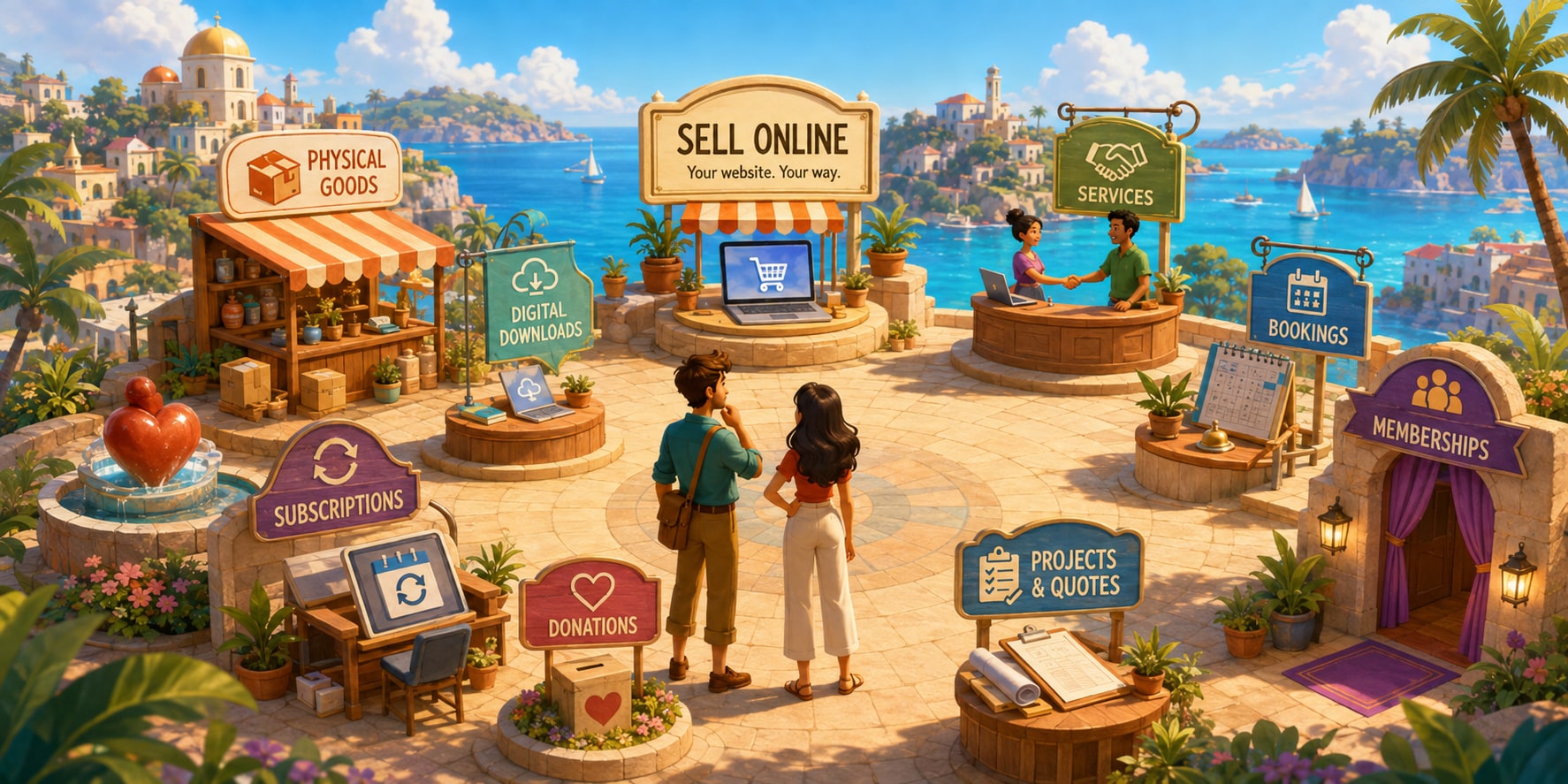
Selling online is not one thing. A shop, a paid download, a booking with a deposit, a subscription, a donation - each needs different machinery, and most need far less than a full shop. Name what you are selling, and the right machinery follows.
The real question is what you are selling, not which software to pick
The decision is usually approached from the platform end. You have heard of one, usually Shopify, and the question becomes whether you need it. The more useful first question is what the sale is, because the answer sorts most of the decision on its own.
This page gives you the words, the options, and where we would start for each - so you can come to any conversation, with us or anyone else, knowing what you are looking at.
The words, translated
Five terms cover almost everything you will hear. None of them needs to be mysterious.
A hosted shop platform. The supplier runs the software, the security and the checkout; you rent it monthly. Shopify is the best-known example. It matters when you want a shop that is somebody's job to keep running, and that somebody is not you. It can run its own storefront, or sit behind a site we build.
Self-hosted, or open source. The shop software is free; the hosting, updates and security are yours to own or pay someone to own. WooCommerce, which runs on WordPress, is the big one. It matters when your business already lives in WordPress and somebody already looks after it.
A payment page, or hosted checkout. A page in your own website's design that takes a card payment for one thing - no catalogue, no basket, no stock. It matters when you are selling a handful of things, a service, or taking donations. Far smaller to build than a shop, and a shop can still be added later.
A merchant of record. A service that sells on your behalf - it is legally the seller, and it handles card fees, global VAT and invoicing for you, for a cut. Common for software. It matters when you sell software or digital products internationally and would rather not become a VAT expert in nine countries.
A platform running behind your own site. The shop platform handles products, checkout, payments and orders, while the pages your customer sees are your own website in your own design. This is how we build a shop. Composable, or fully headless goes further, assembling every part separately - it matters to large retailers with in-house development teams, and below that scale it costs more than it returns.
What are you selling?
Eight kinds of sale cover most businesses. Each one says what the sale needs, and where we would start.
Physical goods, posted or delivered. The sale needs a catalogue, a basket, stock counts, delivery rules and VAT at the checkout. We would start with a hosted shop platform - Shopify, unless your answers point elsewhere.
Digital downloads - files, courses, patterns. The sale needs payment, then a secure download link. Nothing runs out, so there is no stock. We would start with a payment page for a handful of them, and a shop with digital delivery once there is a catalogue.
Software, or a product people subscribe to. The sale needs a pricing page and a sign-up. The product bills itself - the website is the shop window. The website hands over to the product's own billing, or to a merchant of record. Never a shop.
Services at a fixed price. The sale needs payment, and a clear what-happens-next. We would start with a payment page in the site's own design.
Time - appointments, classes, tables. The sale needs a diary people book against, with payment or a deposit at booking. We would start with a booking system, with the rules for cancelling settled before launch.
Projects, quoted first. The sale needs a quote form that asks only what prices the work, then a proposal, then an invoice. We would start with no online sale at all - a well-built enquiry journey, with a payment link for deposits.
Memberships, and paid content. The sale needs recurring payment, and a signed-in area holding what members get. We would start with a payment page with recurring billing, plus a members' sign-in.
Donations, and support. The sale needs one-off and monthly giving, a receipt, and Gift Aid where it applies. A payment page. Never a shop.
Two things run through all eight. First, only one of them needs a shop from day one. Second, none of them names a platform the visitor has to choose - what you sell decides, and the platform follows.
Ways of selling that change the picture
These are not things you sell. They are ways of selling that attach to the kinds above and change what the build needs. Worth knowing by name, because each one is a real piece of work.
Trade customers buying on account brings trade prices behind a sign-in, minimum quantities and invoicing terms. It is the largest single addition to a shop.
Subscriptions and repeat orders bring stored cards, retries when a payment fails, and a portal to pause or cancel. Bigger than it looks.
Selling on marketplaces and social as well means either linking out, which is cheap, or stock that agrees everywhere, which is not.
Selling in person as well means a till and a website sharing one stock list, so neither sells what the other just sold.
Stock in more than one place is its own piece of work. One shelf is a number. Two shelves is a system.
Made to order, or personalised brings options and custom text at the product; customers uploading artwork is the expensive version.
Age-restricted or regulated goods raises which payment services will take you at all - settled before building, not after.
Selling abroad brings currency and regions for goods; for digital things, foreign VAT arrives at the first sale, not at scale.
Who packs and sends changes what the site has to tell somebody after they have paid, and whether anyone is retyping addresses every morning.
Moving an existing shop across is its own piece of work. Products and customers usually come. Orders come in reduced form. What tends not to move cleanly: reviews, unless the review provider is separate from the platform and portable, which is worth choosing for on day one because reviews are years of accumulated work; subscriptions, which often have to be recreated and re-authorised by the customer; web addresses, which need careful redirecting or you lose the search visibility the old shop earned; and discount and loyalty history, which is frequently platform-specific.
What comes as standard, whatever you choose
Cards, Apple Pay and Google Pay, handled by an established payment provider. Your customers' card details never touch your website.
Everything beyond that is optional and worth deciding on purpose: PayPal for people who would rather not type a card in, instalments through Klarna or Clearpay at the checkout, direct debit for money that comes in every month, and paying on account for customers who need it, where invoices stay in the accounting system that already runs them.
The platform landscape, by role
You do not need to study this. It exists so that when a name comes up - from us or anyone else - you can place it in thirty seconds.
Shopify is the mainstream hosted platform, and it is best for most shops of most sizes: the most things working on day one, the fewest to look after. Worth knowing: a monthly fee plus a card percentage, and app costs that can quietly accumulate.
BigCommerce is the like-for-like rival, best for heavily business-to-business shops. It has built-in trade features, and its plans step up with sales volume.
EKM, ShopWired and Bluepark are the British platforms, best when you value UK phone support above a large app ecosystem. Priced in pounds plus VAT, with strong service reputations and smaller ecosystems.
WooCommerce is the WordPress route, best when your business already lives in WordPress and somebody maintains it. The software is free; the ownership is not.
Wix and Squarespace are the site builders with shops, best for a dozen products where the website matters more than the shop. The ceiling arrives quickly: delivery rules, integrations, and moving your data out.
Square Online and Ecwid are the smallest tier, best for a till that also sells online or a small shop bolted onto an existing site. Useful at that size, and outgrown once channels multiply.
Adobe Commerce and composable builds are the enterprise end, best for large catalogues, development teams and unusual requirements. Priced accordingly in money and attention - we will say so if your requirements point here.
Stripe-class checkouts are payment pages, best for downloads, services, deposits and donations. They are the whole payments-without-a-shop tier.
GoCardless-class services handle recurring by direct debit, best for memberships and invoicing on repeat. Direct debit costs less than cards for recurring.
Paddle and Lemon Squeezy are merchants of record, best for selling software internationally. They become the seller and carry the global VAT burden.
Donorbox-class tools handle donations, best for charities and supporter giving. Gift Aid capture and charity card rates are the details that matter.
The cost that scales
A hosted platform has two costs, and the smaller one is the one people compare.
The monthly fee is visible and easy to weigh up. The cost per sale is the one that grows with you, and on any decent trading volume it becomes much the larger number.
Cost per sale has two parts. Card processing you pay whatever you build on. The second part is general to hosted platforms and worth understanding before you choose: take payments through a provider other than the platform's own, and the platform typically adds a further percentage on top of what your provider already charges. On Shopify that additional fee is waived on orders taken through Shopify Payments, Shop Pay, Shop Pay Installments and PayPal Express.
Both rates fall as you move up the plans, which produces a crossover - above a certain turnover, a more expensive plan is cheaper. Worth doing that arithmetic against your own expected volume rather than assuming the entry plan is the economical one.
Published rates change, so treat any figure you read anywhere as indicative and check before committing. What does not change is the shape: a monthly fee, a processing percentage, and a further percentage if you pay through anyone other than the platform's own provider.
Our baseline, and why
Our default position is Shopify. It is the option where the most things work on day one and the fewest need looking after afterwards, it is the platform we standardise on so the time you pay for goes into your shop, and the account is in your name with your products, orders and customers exportable.
Card details also never touch your website, which sharply reduces what you are responsible for under the card industry's security rules.
A default is not a rule. Four situations move us off it, and the proposal states which one applies.
Where a system in your business already owns the stock, the orders or the accounts, the website should read from it rather than argue with it - which can mean keeping what you have and connecting to it.
Where you already run WooCommerce and it works, we connect to it or migrate you off it. We do not build new shops on it, for the same reason we do not build WordPress websites: it puts add-ons written by strangers in the path of your customers.
Where the sale does not need a shop at all - most of the kinds above - a payment page, a booking system or a well-built enquiry journey is the proportionate answer, and costs a fraction of a shop.
And where nothing ready-made holds what you need to keep. Ready-made products are good at taking money and less good at the record underneath it: the download entitlement that has to survive a customer coming back eighteen months later, the member registry that knows who is in and until when, the Gift Aid trail that has to survive an inspection. Where that gap matters to how you run, TwinCoreTech, of which TwinLoom is a trading name, can build it, and the website connects to it like any other system. What TwinCoreTech can build covers when that is worth doing and when it is not.
That is why our scoping journey never asks you to pick a platform. It asks what you would be selling, roughly how many, whether you sell already and whether your product list is ready - and the right route follows from your answers. The platform decision is our work to justify, in writing, in the proposal: the system, who owns the account, what it costs monthly with VAT treatment stated, and how you would leave it if you ever wanted to.
When you should not build a shop at all
When you have very few products and payment links on an ordinary page would do. When your customers buy through a marketplace and your own shop would take orders you are already getting more cheaply elsewhere. When what you sell is a service that needs a conversation, and a checkout would only remove the conversation.
A shop is an operational commitment, not a page.
Questions people ask us
Do I need Shopify to sell online? Only if you need a shop - a catalogue people browse, a basket and stock. A handful of downloads, a donation, a service paid for online or a booking with a deposit can each be done with a payment page or a booking system in your own website's design, at a fraction of the cost, and a full shop can still be added later.
What is the difference between a shop and a payment page? A shop holds a catalogue, a basket and stock counts, and needs delivery rules and VAT at the checkout. A payment page takes a card payment for one thing, in your own site's design, with a receipt - no catalogue, no basket, nothing to keep in stock.
Can I sell online without rebuilding my website? Usually, yes. A payment page or booking journey can be added to an existing site, and where a system in your business already holds your stock or orders, the website can read from it rather than replace it.
We sell software - does any of this apply to us? The shop part does not. Your product takes its own payments through its billing, or through a merchant of record that handles international VAT for you. Your website's job is the pricing page and the sign-up, and that is what we build.
What if nothing off the shelf does what we need? Then we say so, and TwinCoreTech builds the part that is missing. That is usually the record rather than the checkout - entitlements, memberships, supporter registries, project pipelines. It is the last answer we reach for.
Which platform will you recommend for us? The one your answers point at, named in writing in the proposal along with who owns the account, what it costs monthly with VAT treatment stated, and how you would leave it if you ever wanted to.
If you are working this out, send us your requirements - tell us what you would be selling and roughly how many, in as little or as much detail as you like.