
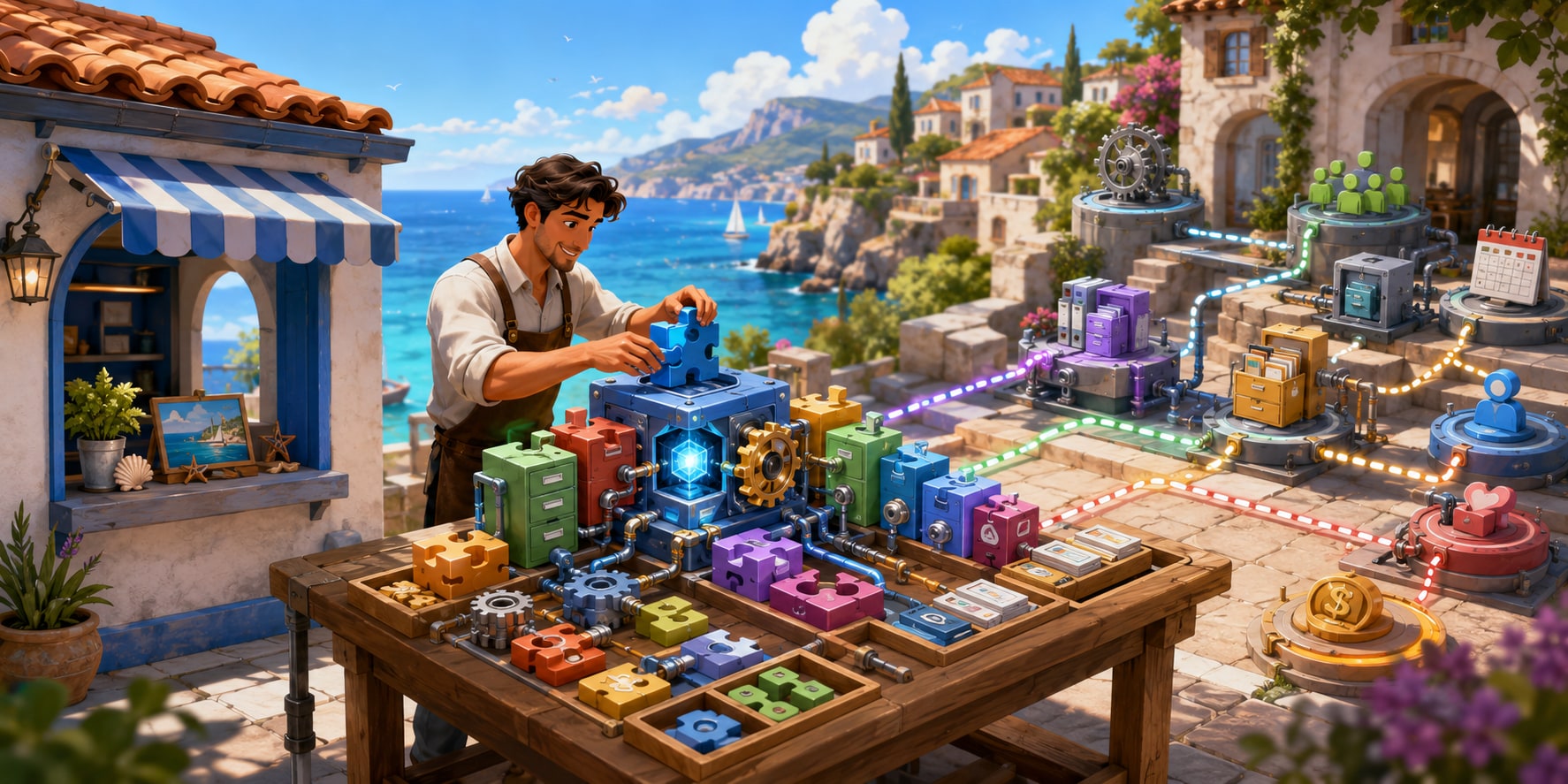
TwinLoom is a trading name of TwinCoreTech Ltd, which builds custom software for businesses. Where a website needs something behind it that cannot be bought off the shelf, that work does not have to go to a third party.
When ready-made is the better answer
Worth saying first, because it applies more often than not.
Payments, shop platforms, booking diaries, accounting packages and email marketing are all well served by established products. They handle edge cases discovered over years, they are maintained by someone else, and they cost a fraction of building the equivalent. We would not build you a booking diary you can buy.
Custom work is worth considering when a ready-made product covers the transaction but not the record underneath it, when the thing you need is specific to how your organisation runs, or when you are paying for several add-ons to approximate something none of them was shaped for.
Where the ready-made market tends to fall short
Four patterns come up repeatedly. In each, taking the money is well covered and what happens afterwards is not.
Tracked downloads. Plenty of tools will sell a file. Fewer hold the entitlement - the link that expires, the log of what was taken and when, and the customer coming back eighteen months later wanting it again. That record is usually scattered across add-ons with nothing owning it.
Memberships, gyms and clubs. What you need to know is who is in, on which plan, with what status, for which period, what it entitles them to, and whether they turned up. Generic subscription tools take the payment. The vertical products that go further are built for one trade, and often not yours.
Donations and friends-of schemes. Generic donation tools cover the gift. What they cover less well is the supporter registry, the state of recurring giving, and a Gift Aid declaration and claim trail that survives inspection.
Quoted projects. Enquiry, pipeline, proposal, invoice. Sometimes the CRM you already run covers this and we connect to it. Sometimes it does not and it is worth building.
Connecting to what you already run
Most custom work is not a new system. It is making the systems you already have talk to each other and to your website.
The ones we are asked about most:
Selling and money - the till or point of sale, card payments, accounting or bookkeeping, stock or inventory.
People - the customer list or CRM, email marketing, memberships and subscriptions, donations and Gift Aid.
Time and place - the booking diary or calendar, rotas and payroll, delivery and couriers, tables or rooms or venue.
The work itself - jobs, tickets or cases, quotes and proposals, the document or file store, courses and learning platforms.
Anything else - listing or portal feeds for property, travel, jobs and marketplaces, and anything already built for you in-house that is still running.
Where a system publishes a way to connect to it, we connect to it. Where it does not, we say so before promising anything, because some systems genuinely cannot be reached from outside. Sometimes the answer is a scheduled export rather than a live connection, and it is better to know that at the start.
Software as the product
Not everything TwinCoreTech builds sits behind a website. Where the software is the business - a tool you sell access to, an internal system your operation runs on, a portal your customers or staff log into - that is built as its own product rather than as an attachment to a marketing site.
>
How it works alongside the website
The people scoping the website and the people building what sits behind it are in the same group, under one contract.
In practice the website and the custom work are usually scoped together and delivered in phases, so something useful goes live before everything is finished.
What custom work costs you beyond the build
Custom software has to be maintained. Dependencies need updating, security patches need applying, and platform changes need responding to. It has to be hosted and backed up. And it has to be documented well enough that somebody other than its author can work on it.
None of that is a reason not to build. It is a reason to build only where the thing is not available to buy, and to include the running cost in the comparison rather than the build cost alone.
When it is not worth it
When a ready-made product does most of what you need and you are describing preferences rather than requirements. When the process you want to encode is still changing month to month. When nobody internally will own the thing once it exists. And when the total cost, including running it, exceeds what the problem costs you today.
That is said at the scoping stage.
If you think you have one of these, send us your requirements - describe what you need to happen, in as little or as much detail as you like.